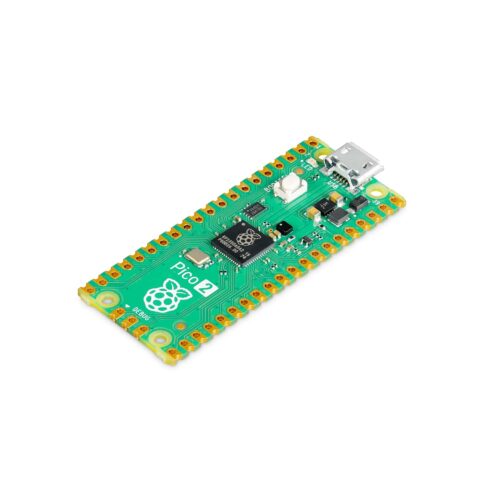
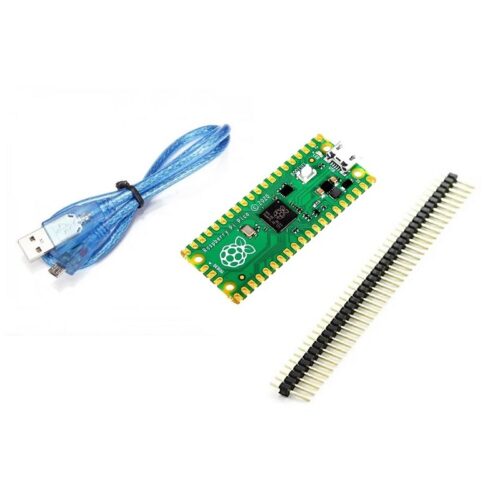
🔧 Raspberry Pi Pico 2 W – Next-Gen Wireless Microcontroller with RP2350
The Raspberry Pi Pico 2 W is the latest generation wireless microcontroller board featuring the revolutionary RP2350 chip with dual-core ARM Cortex-M33 processors running at 150MHz (or dual RISC-V Hazard3 cores), 520KB RAM, and integrated 2.4GHz wireless connectivity (WiFi 4 and Bluetooth 5.2). Building on the success of the Pico W, the Pico 2 W delivers double the RAM, significantly enhanced security features including Arm TrustZone, floating-point acceleration, and improved power efficiency while maintaining full pin compatibility with the original Pico. With 26 GPIO pins (4 analog inputs – one more than Pico), dual UART, dual SPI, dual I2C, 24 PWM channels, enhanced programmable I/O (PIO), and support for MicroPython, C/C++, and Arduino IDE, this board is perfect for advanced IoT projects, secure wireless applications, AI/ML at the edge, professional embedded systems, and next-generation maker projects requiring wireless connectivity and enhanced performance at just $7 USD.
✨ Key Highlights
- 🚀 New RP2350 Chip – Next-gen dual-core @ 150MHz
- ⚡ ARM Cortex-M33 – Or switchable RISC-V Hazard3 cores
- 💾 520KB RAM – Double the Pico W (264KB → 520KB)
- 🔒 Arm TrustZone – Hardware security for secure applications
- 📡 Built-in WiFi – 2.4GHz 802.11n wireless (Infineon CYW43439)
- 📱 Bluetooth 5.2/BLE – Latest Bluetooth standard
- 📊 4 Analog Inputs – One more ADC than original Pico
- ⚡ 24 PWM Channels – 50% more than Pico (12 slices)
- 🎨 Enhanced PIO – 12 state machines (vs 8 on Pico)
- 💰 Only $7 USD – Premium features at incredible value!
📊 Technical Specifications
| 💻 Microcontroller |
RP2350B (Raspberry Pi next-gen silicon) |
| 🔧 CPU Options |
Dual-core ARM Cortex-M33 @ 150MHz OR dual RISC-V Hazard3 |
| 💾 SRAM |
520KB on-chip SRAM (double Pico W’s 264KB) |
| 💾 Flash Memory |
4MB onboard QSPI flash (double Pico W’s 2MB) |
| 🔒 Security |
Arm TrustZone-M, secure boot, 8KB OTP memory |
| 📡 Wireless Chip |
Infineon CYW43439 (WiFi + Bluetooth) |
| 📡 WiFi |
2.4GHz IEEE 802.11n (WiFi 4), single-band |
| 📱 Bluetooth |
Bluetooth 5.2, Bluetooth Low Energy (BLE) |
| 🔌 GPIO Pins |
26× multifunction GPIO pins (pin-compatible with Pico) |
| 📊 ADC |
4× 12-bit ADC channels @ 500ksps (GPIO 26-29) |
| ⚡ PWM |
24× PWM channels (12 slices, 2 channels each) |
| 🔌 UART |
2× UART interfaces |
| 📡 SPI |
2× SPI interfaces |
| 📡 I2C |
2× I2C interfaces |
| 🎨 PIO |
12× Programmable I/O state machines (4 more than Pico) |
| 🔢 FPU |
Hardware floating-point unit (single & double precision) |
| ⚡ Operating Voltage |
1.8V – 5.5V (3.3V logic levels) |
| 🔋 Power Input |
5V via micro USB or VSYS pin (1.8-5.5V) |
| 🔋 Current Draw |
~50-100mA typical (WiFi active), improved efficiency vs Pico W |
| 🌡️ Operating Temp |
-20°C to +85°C |
| 📏 Dimensions |
51mm × 21mm × 1mm (same as Pico/Pico W) |
| ⚖️ Weight |
~3 grams (bare board) |
🆕 What’s New in Pico 2 W vs Pico W
| Double RAM |
520KB vs 264KB – better multitasking, larger programs |
| Double Flash |
4MB vs 2MB – more storage for code and data |
| Faster CPU |
150MHz vs 133MHz – 13% speed increase |
| ARM Cortex-M33 |
vs M0+ – faster, more features, DSP instructions |
| RISC-V Option |
Can boot as RISC-V instead of ARM (switchable!) |
| Hardware FPU |
Single & double precision floating-point acceleration |
| Arm TrustZone |
Hardware security isolation for secure applications |
| 4 ADC Channels |
vs 3 ADC – one additional analog input |
| 24 PWM Channels |
vs 16 PWM – 50% more PWM capability |
| 12 PIO Machines |
vs 8 PIO – 50% more programmable I/O |
🎯 Perfect For
- 🤖 Advanced IoT – Complex wireless sensor networks, edge computing
- 🔒 Secure Applications – TrustZone for secure data, cryptography
- 🧠 AI/ML at Edge – TinyML, neural networks, pattern recognition
- 📊 Data Processing – Hardware FPU for fast calculations
- 🏠 Smart Home Pro – Advanced automation, security systems
- 🎮 Wireless Gaming – More RAM for complex game logic
- 📡 Mesh Networks – BLE mesh, multi-node communication
- 🔬 Professional Projects – Commercial products, industrial control
🆚 Pico 2 W vs Pico W vs ESP32
| Feature |
Pico 2 W |
Pico W |
ESP32 |
| CPU Cores |
2 @ 150MHz |
2 @ 133MHz |
2 @ 240MHz |
| CPU Type |
✅ M33 or RISC-V |
M0+ |
Xtensa LX6 |
| RAM |
✅ 520KB |
264KB |
520KB |
| Flash |
✅ 4MB |
2MB |
4-16MB |
| WiFi |
✅ 2.4GHz |
✅ 2.4GHz |
✅ 2.4GHz |
| Bluetooth |
✅ BLE 5.2 |
✅ BLE 5.2 |
BLE 4.2 |
| Security |
✅ TrustZone |
❌ No |
Secure boot |
| Hardware FPU |
✅ Yes (SP+DP) |
❌ No |
✅ Yes (SP) |
| ADC Channels |
4× 12-bit |
3× 12-bit |
✅ 18× 12-bit |
| PIO |
✅ 12 machines |
✅ 8 machines |
❌ No |
| Price |
✅ $7 |
✅ $6 |
$8-15 |
✅ Key Advantages of Pico 2 W
- 💾 Double RAM – 520KB enables complex programs and multitasking
- 🚀 Faster Performance – M33 cores + 150MHz + FPU = significant boost
- 🔒 Hardware Security – Arm TrustZone for secure IoT applications
- 🎨 More Resources – 4 ADC, 24 PWM, 12 PIO vs Pico W
- 🔢 FPU Acceleration – Fast floating-point math (scientific, AI/ML)
- 🔄 ARM or RISC-V – Choose architecture at boot time
- 📡 Same Wireless – WiFi + BLE like Pico W, proven reliable
- 🔌 Pin Compatible – Drop-in upgrade from Pico/Pico W
- 💰 Incredible Value – Only $7 for premium features
- 🐍 Full Compatibility – MicroPython, C/C++, Arduino support
⚠️ Important Considerations
- 📡 2.4GHz WiFi Only – No 5GHz band (same as Pico W)
- 🔌 3.3V Logic – Not 5V tolerant (requires level shifters)
- 🔧 Headers Unpopulated – Requires soldering (or buy Pico 2 WH variant)
- 🆕 Newer Software – Some libraries still being updated for RP2350
- ⚡ Slightly More Power – More features = slightly higher consumption vs Pico W
- 💰 $1 More – Than Pico W ($7 vs $6)
- 📏 Availability – May have limited stock initially (new product)
🔒 Security Features (Arm TrustZone-M)
| Arm TrustZone-M |
Hardware isolation between secure and non-secure code |
| Secure Boot |
Verify firmware authenticity before execution |
| 8KB OTP Memory |
One-time programmable for keys, configuration |
| Memory Protection |
MPU (Memory Protection Unit) prevents unauthorized access |
| Cryptographic Engine |
Hardware acceleration for AES, SHA-256 |
| Secure Storage |
Protected flash regions for sensitive data |
| Use Cases |
Payment systems, medical devices, secure IoT, DRM |
🔢 Hardware Floating-Point Unit (FPU)
| Single Precision |
32-bit float operations (standard float) |
| Double Precision |
64-bit float operations (double) – rare in microcontrollers! |
| Performance Gain |
~10-100× faster than software floating-point |
| Applications |
Scientific computing, DSP, AI/ML, physics engines |
| Math Functions |
Fast sin, cos, sqrt, division, multiplication |
| Energy Efficient |
Less CPU time = lower power consumption |
🔄 ARM vs RISC-V Architecture Choice
| ARM Cortex-M33 |
Industry standard, mature ecosystem, best compatibility |
| RISC-V Hazard3 |
Open-source ISA, growing ecosystem, future-proof |
| Switching |
Select at boot via BOOTSEL button + firmware |
| Performance |
Similar performance, both run at 150MHz |
| Compatibility |
ARM has more libraries currently, RISC-V growing |
| Use ARM For |
Maximum compatibility, production projects, beginners |
| Use RISC-V For |
Open-source preference, learning RISC-V, experimentation |
🐍 MicroPython Quick Start
| Getting Started with Pico 2 W (MicroPython) |
# 1. Download MicroPython for Pico 2 W
# Visit: micropython.org/download/rp2-pico-2-w/
# Download latest .uf2 file (ARM or RISC-V version)
# 2. Install firmware
# – Hold BOOTSEL button on Pico 2 W
# – Connect USB (still holding button)
# – Release when RPI-RP2 drive appears
# – Drag .uf2 file to drive
# – Pico 2 W reboots with MicroPython
# 3. Test WiFi with Thonny IDE
import network
import time
wlan = network.WLAN(network.STA_IF)
wlan.active(True)
wlan.connect(‘YOUR_SSID’, ‘YOUR_PASSWORD’)
while not wlan.isconnected():
print(‘Connecting…’)
time.sleep(1)
print(‘WiFi Connected!’)
print(‘IP:’, wlan.ifconfig()[0])
# 4. Test improved performance
import machine
print(‘CPU Freq:’, machine.freq() // 1_000_000, ‘MHz’)
print(‘RAM:’, machine.mem_info()) # Shows 520KB available!
|
🎓 Advanced Example Projects
- 🧠 TinyML Image Recognition – Neural network on device with FPU
- 🔒 Secure IoT Gateway – TrustZone for encrypted communications
- 📊 Real-Time Data Logger – 4 ADC channels + WiFi cloud upload
- 🎮 Wireless Game Console – More RAM for complex games
- 🌈 Large LED Matrix – 12 PIO machines for massive displays
- 📡 BLE Mesh Network – Multi-node sensor network
- 🎵 WiFi Audio Streamer – FPU for audio processing
- 🤖 AI Robot Controller – ML inference for autonomous behavior
💡 Pro Tips for Pico 2 W
- 💾 Leverage Extra RAM – Use 520KB for larger buffers, more complex programs
- 🔢 Use FPU – Significant speedup for math-heavy applications
- 🔒 Implement TrustZone – Isolate secure code for professional IoT
- 🎨 Extra PIO Machines – 12 PIO enables more complex parallel interfaces
- 📊 4th ADC Channel – One more analog input than Pico W
- ⚡ Overclock Safely – Can run faster than 150MHz if needed
- 🔄 Try RISC-V – Experiment with open-source architecture
- 💾 4MB Flash – Store more code, data, or filesystems
📊 Performance Benchmarks
| CPU Speed |
~13% faster than Pico W (150MHz vs 133MHz) |
| Floating-Point |
~10-100× faster with hardware FPU vs software |
| RAM Capacity |
2× Pico W (520KB vs 264KB) |
| Flash Storage |
2× Pico W (4MB vs 2MB) |
| PWM Channels |
50% more than Pico W (24 vs 16) |
| PIO Machines |
50% more than Pico W (12 vs 8) |
🔍 Troubleshooting Guide
| Not Recognized by PC |
Try different USB cable (data cable required, not charge-only) |
| BOOTSEL Not Working |
Hold button BEFORE USB, keep holding until RPI-RP2 appears |
| Library Not Working |
Ensure RP2350-compatible version (some still updating) |
| WiFi Issues |
Same as Pico W – check SSID/password, 2.4GHz network |
| Out of Memory |
Unlikely with 520KB! Check for memory leaks in code |
| FPU Not Working |
Ensure using float/double types, compiler optimization enabled |
| RISC-V Boot Issues |
Use specific RISC-V firmware, not ARM version |
📦 Package Contents
- ✅ 1× Raspberry Pi Pico 2 W board (RP2350B chip)
- ⚠️ Note: Board only – no cables or headers included
- ⚠️ Note: GPIO headers unpopulated (requires soldering)
- ⚠️ Note: Micro USB cable sold separately
- ⚠️ Alternative: Pico 2 WH available with pre-soldered headers
- ✅ Tip: Consider official Pico 2 W kit with accessories
🔋 Power Consumption
| Sleep Mode (Deep) |
~0.8-1mA @ 3.3V (WiFi disabled) |
| Idle (WiFi Disabled) |
~25-35mA @ 5V |
| Active (WiFi Connected) |
~50-100mA @ 5V (similar to Pico W) |
| Active (WiFi TX/RX) |
~100-200mA @ 5V (peak) |
| Heavy Computation |
~60-120mA @ 5V (both cores + FPU active) |
| Recommended PSU |
5V 1A USB adapter or quality USB port |
💰 Pricing & Availability
| Raspberry Pi Pico 2 W |
$7 USD (official MSRP) |
| Raspberry Pi Pico 2 WH |
$8 USD (with pre-soldered headers) |
| Raspberry Pi Pico 2 |
$5 USD (no wireless) |
| Raspberry Pi Pico W |
$6 USD (previous generation) |
| Value |
✅ Best price/performance for wireless microcontroller |
🔧 Compatible Accessories
- 🔌 Pin Compatible – All Pico/Pico W accessories work with Pico 2 W
- 📺 Displays – SSD1306 OLED, ST7789 TFT, character LCDs
- 🌡️ Sensors – DHT22, BME280, MPU6050, all standard sensors
- 💡 LEDs – WS2812B NeoPixels, APA102, LED strips
- 🎩 Pico HATs – Display packs, audio packs, motor drivers
- 🔋 Power – LiPo batteries, UPS modules, solar panels
- 📡 Communication – LoRa, nRF24L01+ (in addition to WiFi/BLE)
💻 Software Support
- ✅ MicroPython – Official support with RP2350 features
- ✅ C/C++ SDK – pico-sdk with RP2350 support
- ✅ Arduino IDE – Community core being updated
- ✅ CircuitPython – Adafruit adding RP2350 support
- ✅ Rust – Embassy and other embedded Rust frameworks
- ✅ TinyGo – Go support for RP2350
- ⚠️ Note: Some libraries still being updated for new chip
🧠 AI/ML Capabilities
| TensorFlow Lite Micro |
Run neural networks on device |
| Hardware FPU |
Accelerates matrix operations for ML |
| 520KB RAM |
Larger models and datasets possible |
| DSP Extensions |
M33 includes DSP instructions for signal processing |
| Edge AI |
Voice recognition, gesture detection, anomaly detection |
| Inference Speed |
~2-10× faster than Pico W for ML workloads |
🛡️ Product Information
✅ Raspberry Pi Pico 2 W – Next-Gen Wireless Microcontroller with RP2350
✅ Manufacturer: Raspberry Pi Ltd (official product, latest generation)
✅ Microcontroller: RP2350B (next-gen Raspberry Pi silicon)
✅ CPU: Dual-core ARM Cortex-M33 @ 150MHz OR dual RISC-V Hazard3 (switchable!)
✅ RAM: 520KB on-chip SRAM (double Pico W’s 264KB)
✅ Flash: 4MB onboard QSPI flash (double Pico W’s 2MB)
✅ Wireless: Infineon CYW43439 chip (WiFi + Bluetooth, same as Pico W)
✅ WiFi: 2.4GHz IEEE 802.11n (WiFi 4), WPA2/WPA3 security
✅ Bluetooth: Bluetooth 5.2, BLE (Bluetooth Low Energy)
✅ Security: Arm TrustZone-M, secure boot, 8KB OTP memory, cryptographic engine
✅ FPU: Hardware floating-point unit (single & double precision)
✅ GPIO: 26× multifunction pins (pin-compatible with Pico/Pico W)
✅ ADC: 4× 12-bit 500ksps ADC (GPIO 26-29, one more than Pico W)
✅ PWM: 24 PWM channels (12 slices × 2, vs 16 on Pico W)
✅ Interfaces: 2× UART, 2× SPI, 2× I2C (configurable GPIO)
✅ PIO: 12× Programmable I/O state machines (vs 8 on Pico W)
✅ USB: Micro USB (device mode, USB 1.1 full-speed)
✅ Power: 5V via USB or 1.8-5.5V via VSYS pin
✅ Dimensions: 51mm × 21mm × 1mm (same footprint as Pico/Pico W)
⚠️ Important: Official MSRP $7 USD (Pico 2 W), $8 USD (Pico 2 WH with headers). Next-generation upgrade from Pico W: 2× RAM (520KB), 2× flash (4MB), faster CPU (150MHz), hardware FPU, Arm TrustZone security. ARM or RISC-V: Choose architecture at boot time via firmware selection. Pin-compatible: Drop-in replacement for Pico/Pico W in most projects. Headers unpopulated: Requires soldering or buy Pico 2 WH variant. Security features: TrustZone-M for isolated secure code execution, secure boot verification. FPU advantage: 10-100× faster floating-point math vs software emulation. WiFi/Bluetooth: Same proven wireless chip as Pico W (CYW43439). Programming: MicroPython (easiest), C/C++ SDK, Arduino IDE (community support). Bootloader: Hold BOOTSEL + connect USB, drag .uf2 firmware file. Performance: ~2-5× faster than Pico W for math-intensive tasks. AI/ML capable: Hardware FPU + 520KB RAM enables TensorFlow Lite Micro. Perfect for: Advanced IoT, secure applications, AI/ML edge computing, professional embedded systems. Not suitable for: 5GHz WiFi needs, classic Bluetooth audio, budget-critical projects (Pico W cheaper). Best next-gen wireless microcontroller available!